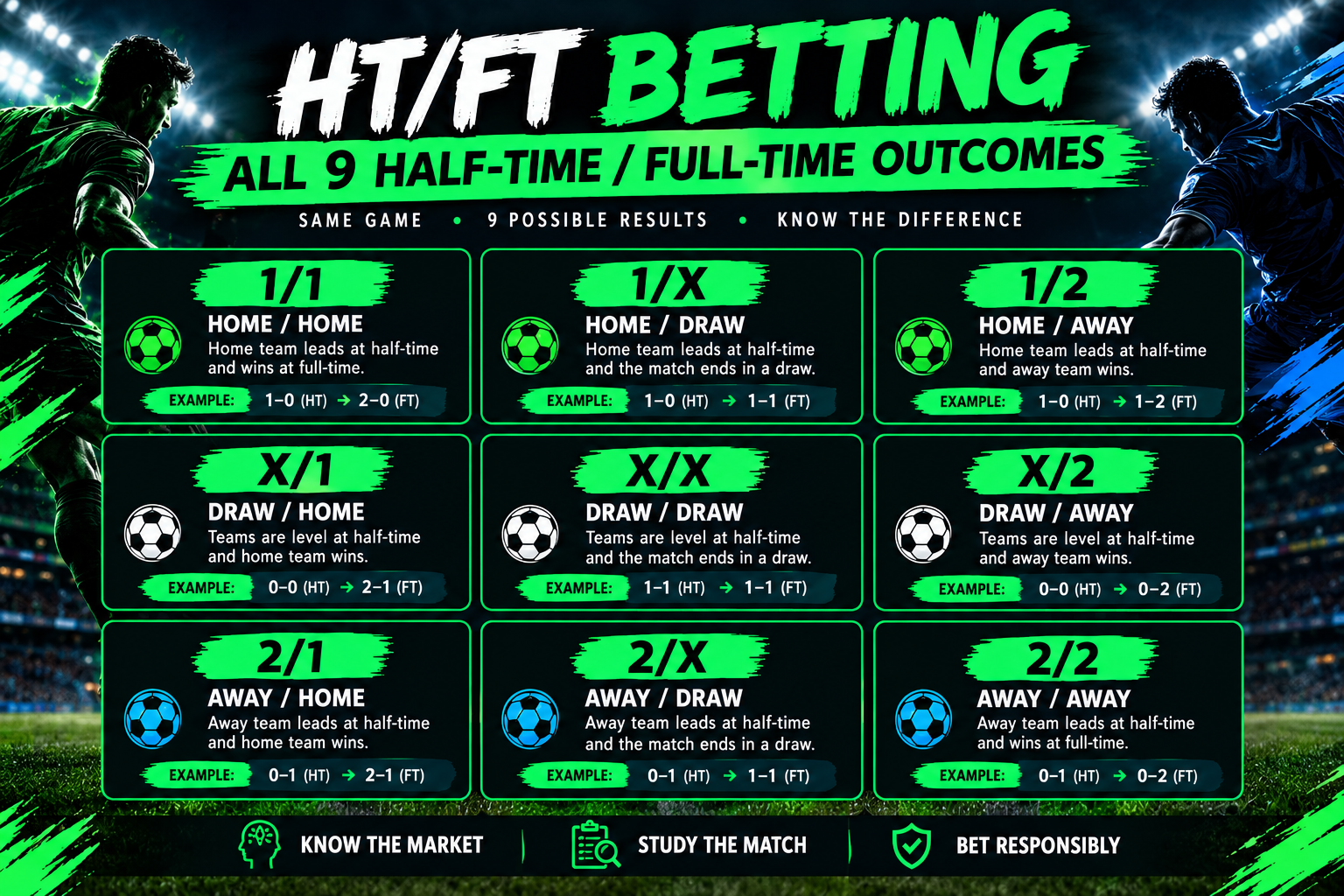
HT/FT betting (half-time/full-time) is a football (soccer) bet where you predict the result at half-time and the result at full-time in a single selection. Both parts must be correct, so the odds are much longer than a standard match-result bet. In HT/FT notation 2/1 means the away team is leading at half-time and the home team wins the match.
This guide lists all nine outcomes, shows how the price is built, and explains when HT/FT is worth using.
How HT/FT notation works
Each result is written with the same three symbols used in 1X2 betting: 1 for a home win, X for a draw and 2 for an away win. The first symbol is the half-time result and the second is the full-time result. Full time means 90 minutes plus stoppage time, so extra time and penalties are excluded unless the bookmaker says otherwise.
Three half-time results combined with three full-time results give nine possible outcomes.
|
|
|
|
|
|
|
|
|
Home side ahead at the break and holds on to win
|
|
|
|
|
Home side ahead at the break, pegged back to a draw
|
|
|
|
|
Home side ahead at the break, loses the match
|
|
|
|
|
Level at the break, home side score later and win
|
|
|
|
|
Level at the break and level at the end
|
|
|
|
|
Level at the break, away side win it later
|
|
|
|
|
Away side ahead at the break, home side come back to win
|
|
|
|
|
Away side ahead at the break, home side pull level
|
|
|
|
|
Away side ahead at the break and hold on to win
|
The four “turnaround” results are 1/2, 2/1, 1/X and 2/X. The leading side at half-time fails to win. They pay the longest prices.
A worked example: Manchester City v Brentford
These prices are illustrative and rounded. City are priced at 1.50 to win the match, which is the same price used in our double chance guide.
Say the match ends 2-0 to City and the score was 0-0 at half-time. That result is X/1. A £10 stake at 3.80 returns £38, a profit of £28. The same £10 on City to win at 1.50 would have returned £15, a profit of £5.
The extra profit comes with extra risk. If City had scored in the first half, the X/1 bet would have lost even though City won. A win-only bet would have paid.
How the price is built
An HT/FT price links the two halves of a match, because a team leading at half-time is much more likely to win than a team that is level, so the half-time and full-time prices cannot simply be multiplied. Bookmakers price each of the nine outcomes from the chance of the half-time result and the chance of the full-time result given that half-time result.
Here is a simple illustration with assumed figures. Suppose a bookmaker thinks City have a 45% chance of leading at half-time, and an 85% chance of winning if they do. The chance of 1/1 is 0.45 x 0.85 = 0.3825, which is 38.25%. Decimal odds are 1 divided by that probability, so the fair price is 1 / 0.3825 = 2.61. The bookmaker then shades it down to build in a margin, which gives the 2.60 shown above.
Implied probability from the prices in the table: 1/1 at 2.60 is 38.5%, X/1 at 3.80 is 26.3%, X/X at 6.50 is 15.4% and 2/1 at 21.00 is 4.8%. To convert any decimal price, divide 1 by the odds.
When HT/FT is worth using
1. A strong favourite that tends to start slowly. If the match-winner price is too short to bet, X/1 can offer a longer price for the same view that the favourite wins.
2. A high-scoring second-half side. Teams that score late create more X/1 and X/2 results than their pre-match price suggests.
3. A matchup between two cautious sides. X/X is the natural result when both teams protect a 0-0 start. It is worth checking how often each side has drawn at both half-time and full-time.
4. A small stake for a bigger return. HT/FT suits a small stake that you can afford to lose, since each bet needs two things to go right.
Common mistakes to avoid
• Backing 1/1 on a heavy favourite. The price is close to the match-winner price but you carry the extra risk of the half-time result.
• Chasing turnaround results. 2/1 and 1/2 pay big prices because they rarely happen. A long price is not a reason to bet.
• Covering several outcomes without checking the maths. If you split your stake over 1/1, X/1 and 2/1 you have backed a home win at a lower blended price than the match-winner market.
• Ignoring half-time rules. The first-half result settles at 45 minutes plus first-half stoppage time. Check the operator rules.
Frequently asked questions
What does 2/1 mean in HT/FT betting?
2/1 means the away team leads at half-time and the home team wins the match. The first number is the half-time result and the second is the full-time result.
How many outcomes are there in HT/FT betting?
There are nine: three half-time results (home, draw, away) combined with three full-time results.
Does extra time count in HT/FT bets?
Usually no. Most bookmakers settle HT/FT on the first 45 minutes and the full 90 minutes with stoppage time. Always read the market rules.
Is HT/FT harder to win than a match-result bet?
- Yes. A match-result bet needs one correct call and HT/FT needs two, so the strike rate is lower and the prices are longer.
- What is the difference between HT/FT and a half-time result bet?
A half-time result bet settles on the score at 45 minutes only. HT/FT settles on both the half-time and full-time results together.
See today’s selections on our 1X2 and HT/FT predictionspage. Other markets: first-half goal predictions, draw predictions, correct score predictions and over 1.5 goals. Browse the Matchplug blog or see our VIP tips. Related: Double chance betting explained | Asian handicap explained | How to read betting odds
Gamble responsibly. 18+ (21+ in US states where required). Free, confidential help: BeGambleAware and GamCare (UK), 1-800-GAMBLER (US), ConnexOntario (Canada), Gambling Help Online (Australia).